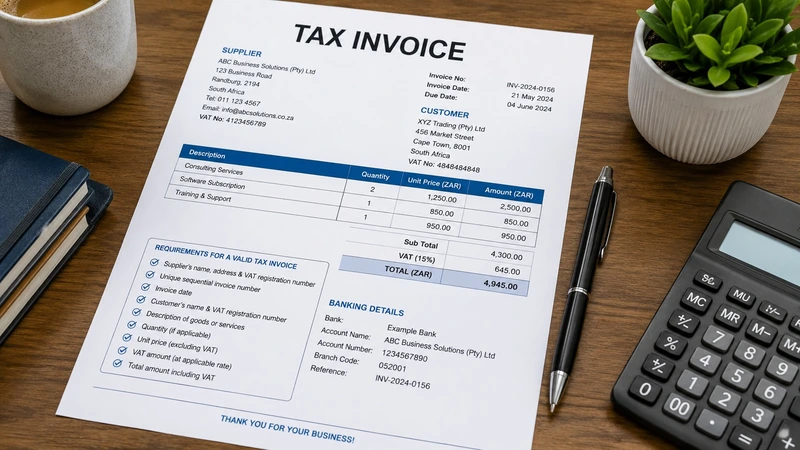

VAT on discounts follows one principle: VAT is charged on the value of the supply. A discount reduces that value, so it reduces the VAT with it. The complication is timing: an unconditional discount is known at invoicing, and a settlement discount is not.
VAT on discounts that are unconditional
A negotiated reduction, agreed before or at invoicing. Straightforward:
| Amount | |
|---|---|
| Value before discount | R 5 700,00 |
| Less 10% | R 570,00 |
| Value of supply | R 5 130,00 |
| VAT at 15% | R 769,50 |
| Total | R 5 899,50 |
Apply the discount to the value first, then calculate VAT on what remains. Never take the discount off the VAT-inclusive total and work backwards, because the two do not reconcile.
Settlement discounts
Conditional on the client paying by a stated date. At the point of invoicing you do not know whether it will apply, and the supply has already taken place.
The common practical approach:
- Issue the tax invoice for the full amount, with the settlement terms stated on it.
- If the client pays early and takes the discount, issue a credit note for the discount and the VAT on it.
- If they do not, nothing further is required.
The credit note is what adjusts the output tax in the period it is issued, which is why the discount cannot simply be netted off when the payment arrives.
Where it goes wrong
- Deducting a settlement discount at invoicing, then chasing the balance when the client pays late
- Issuing a credit note without VAT on it, so the output tax is never adjusted
- Applying the discount to the inclusive total and leaving the VAT line unchanged
- Treating a discount as a bad debt write-off, which is a different thing entirely
Common questions
Do I show the discount on the tax invoice?
For an unconditional discount, yes. The document should show how the value was arrived at.
What if the client takes the discount but pays late?
The condition was not met, so the discount was not earned. Ask for the difference rather than issuing the credit note.
Does a credit note need VAT on it?
Where it adjusts a supply on which VAT was charged, yes. Otherwise the output tax is never corrected.
Apply a discount and the VAT recalculates on the reduced value automatically.
Create a VAT-ready invoice- Value-Added Tax Act 89 of 1991, sections 10 and 21
- SARS, Value-Added Tax
Disclaimer: This content is for general information only and does not constitute legal, tax, accounting or financial advice. Always confirm important requirements with SARS, the relevant authority or a qualified professional.