
In short
- Compulsory registration starts once your taxable turnover passes R2.3 million in any 12-month period.
- That threshold rose from R1 million on 1 April 2026. A lot of published guidance is now out of date.
- Voluntary registration is available from R120,000 in taxable turnover.
- If you are not registered, you may not charge VAT and your documents are ordinary invoices, not tax invoices.
- SARS, Value-Added Tax
The VAT registration threshold is the point at which registration stops being optional. You must register once your taxable turnover exceeds R2.3 million in any consecutive 12-month period. Below that, registration is optional.
This changed recently. The compulsory threshold sat at R1 million for years, and SARS raised it to R2.3 million with effect from 1 April 2026. If you read something that still says R1 million, check its date before you act on it.
How the VAT registration threshold is tested
It is a rolling test, not a financial year. At any point you look back over the previous 12 months and add up your taxable supplies. You also have to register if you have a written agreement that will take you over the threshold in the next 12 months.
Turnover means taxable supplies, not profit. A business turning over R2.4 million and making very little on it still crosses the line.
Voluntary registration from R120,000
You may register voluntarily once taxable turnover passes R120,000 in the previous 12 months. Whether you should is a commercial question, not a compliance one.
| Registering makes sense when | Registering hurts when |
|---|---|
| Your customers are VAT vendors who claim the input tax back | Your customers are the public, who cannot claim it back |
| You buy significant VAT-bearing stock or equipment | You have few input costs, so there is little to claim |
| You are tendering to companies or government | Your pricing is compared directly against unregistered competitors |
The trap for small service businesses is the second column. Adding 15% to a price a private customer pays makes you 15% more expensive overnight, with nothing to offset it.
What changes the day you register
- You charge 15% VAT on taxable supplies.
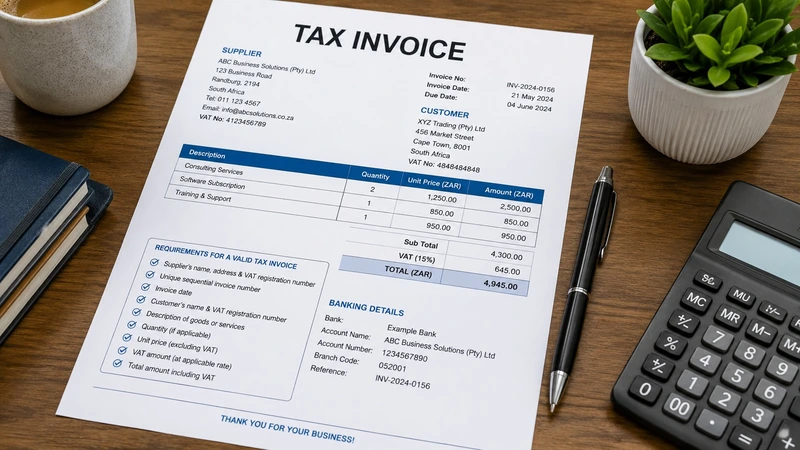
- Your invoices become tax invoices and must carry your VAT number and everything else section 20 requires.
- You submit VAT returns on your assigned cycle, usually every two months.
- You can claim input VAT on qualifying business purchases.
- You keep records for five years.
Charging VAT before you are registered is a contravention of the VAT Act. If you are waiting on a registration number, do not add VAT to invoices in the meantime.
Common questions
Is the R2.3 million figure turnover or profit?
Taxable turnover. Profit does not come into it.
Does the threshold include zero-rated supplies?
Zero-rated supplies are taxable supplies at a rate of 0%, so they count toward the threshold. Exempt supplies do not.
What is the VAT rate in South Africa?
15%. The increases announced in the 2025 Budget were reversed and the rate was unchanged in 2026.
Can I deregister if my turnover drops?
Yes. Vendors falling below the compulsory threshold may apply to SARS to deregister.
Quote to Invoice puts your VAT number and business details on every document automatically. It is free to use.
Create a VAT-ready invoice- Value-Added Tax Act 89 of 1991
- SARS, Value-Added Tax
- SARS, Budget 2026 frequently asked questions on the VAT registration threshold
Disclaimer: This content is for general information only and does not constitute legal, tax, accounting or financial advice. Always confirm important requirements with SARS, the relevant authority or a qualified professional.