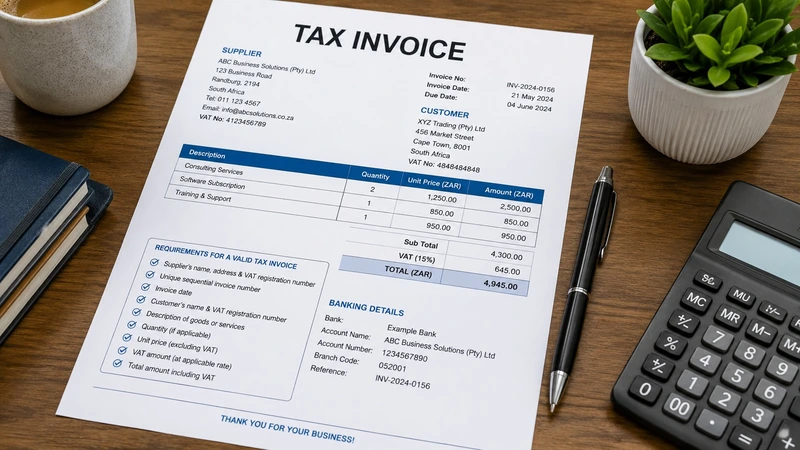

Bad debt relief exists because on the invoice basis you account for VAT when you issue the invoice, not when you are paid. If the client never pays, you have handed SARS output tax on money you never received.
Bad debt relief exists for that situation. It allows a deduction in specified circumstances, subject to conditions.
The general shape of bad debt relief
- The supply must have been a taxable supply on which you accounted for output tax.
- The debt must have been written off as irrecoverable, not merely overdue.
- There are time limits on when the deduction can be claimed.
- If the client subsequently pays, the amount recovered must be accounted for again.
The conditions are specific and the detail matters, so confirm your position against current SARS guidance or with a registered tax practitioner before adjusting a return. This is not a place to work from a general article, including this one.
Written off, not overdue
This is the distinction people get wrong. An invoice at 90 days is overdue. Relief attaches to a debt you have genuinely written off as irrecoverable in your records, having taken reasonable steps to recover it.
Which means the process matters:
- Follow your collection sequence and document it.
- Make a formal demand.
- Decide, and record, that the debt is irrecoverable.
- Write it off in your records, with the date.
- Only then consider the VAT position.
The time limit catches people
Small businesses often leave old debts sitting on the books for years rather than writing them off, because writing off feels like giving up. By the time they do, the window for relief may have closed.
Reviewing debtors properly once a quarter, and writing off what is genuinely gone, is worth more than the tidiness suggests.
If they pay later
Recovery after a write-off is not a windfall. The amount recovered has to be brought back into account for VAT. Keep the record of what was written off so this is a lookup rather than a reconstruction.
Common questions
Does this apply on the payments basis?
Vendors accounting on a payments basis have not declared output tax on unpaid invoices, so the position differs. Confirm which basis you are on.
How long do I have?
There are time limits. Check the current position rather than assuming, particularly on older debts.
Do I need proof I tried to collect?
Keeping the record of your collection attempts is sensible in any event, and supports the write-off decision.
Keep every document and its payment history in one place, so a write-off decision is evidenced.
Create a VAT-ready invoice- Value-Added Tax Act 89 of 1991, section 22
- SARS, Value-Added Tax
- SARS, Value-Added Tax
Disclaimer: This content is for general information only and does not constitute legal, tax, accounting or financial advice. Always confirm important requirements with SARS, the relevant authority or a qualified professional.