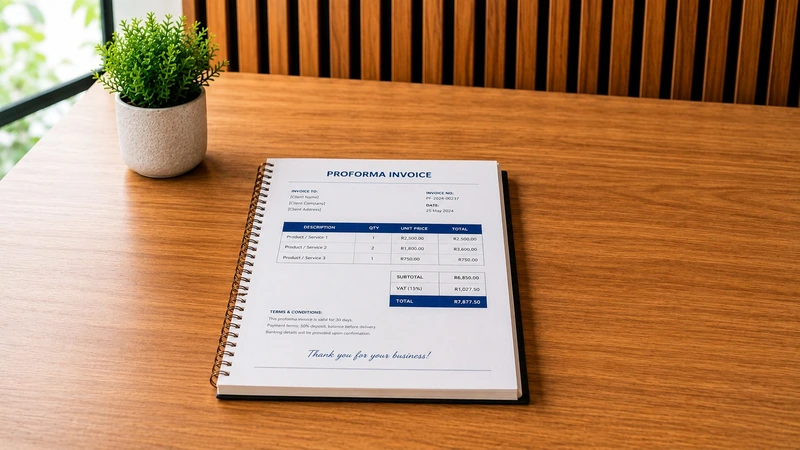
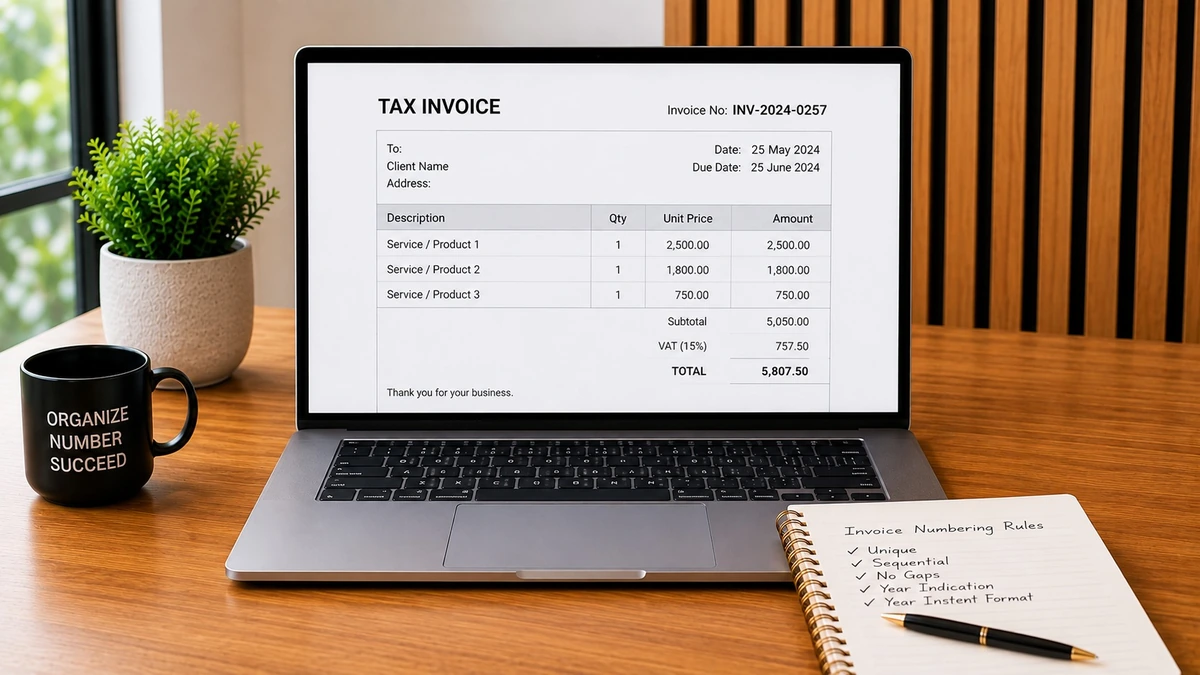
Invoice numbering has one rule that is not negotiable: every invoice needs a unique, sequential number. For a tax invoice this is not optional: section 20 of the VAT Act lists a serial number among the required fields.
Invoice numbering formats that work
| Format | Example | Suits |
|---|---|---|
| Simple sequential | INV-0148 | Most small businesses |
| Year prefixed | 2026-0148 | Businesses that report by year |
| Client coded | ACM-0032 | Few clients, high volume each |
| Document typed | QUO-0148 / INV-0148 | Anyone issuing both quotes and invoices |
The last one is worth adopting even if you start small. Separate sequences for quotations and invoices stop the two colliding in your records and make a statement far easier to read.
Rules to follow
- Never reuse a number. Not even for a cancelled invoice.
- Never leave gaps. A missing number looks like a deleted invoice to anyone auditing you.
- Cancel with a credit note, not by deleting. The original stays in the sequence and the credit note reverses it.
- Keep one sequence per document type, not one per client, unless you have a reason.
- Do not restart annually unless your format includes the year, or you will create duplicates.
What to avoid
Dates as numbers, such as 20260814, fail as soon as you issue two invoices in a day. Random numbers make it impossible to tell whether anything is missing. Starting at 1 is fine, though many businesses start at 100 or 1000 so an early invoice does not advertise how new they are.
Common questions
Can I change my numbering format?
Yes, but do it cleanly at a period end and never in a way that repeats a number you have already issued.
What if I discover a gap?
Note what happened and keep the record. An explained gap is fine; an unexplained one invites questions.
Do quotations need sequential numbers?
There is no legal requirement, but a sequence makes your own records usable and looks more professional to a client.
Quote to Invoice numbers each document automatically, with separate sequences for quotes and invoices.
Create your invoice- Value-Added Tax Act 89 of 1991, section 20
Disclaimer: This content is for general information only and does not constitute legal, tax, accounting or financial advice. Always confirm important requirements with SARS, the relevant authority or a qualified professional.